
MOPA LASER is Better Than Q-Switched Fiber Lasers
Laser marking has become essential across industries such as electronics, automotive, aerospace, medical devices, and packaging. Its ability to produce high-resolution, durable marks with minimal material impact makes it a superior alternative to traditional methods. While Q-switched fiber lasers have long been the standard, MOPA (Master Oscillator Power Amplifier) lasers are redefining the landscape with enhanced control, precision, and versatility.
Key Differences and Application Insights
Precision Marking in Electronics and Semiconductors
Applications such as ITO film patterning and microelectronic component marking demand micro-level precision. Q-Switched Lasers: Inflexible pulse shaping often results in rough edges and lack of detail. MOPA Lasers: Tunable parameters ensure clean edges, sharp lines, and highly accurate feature definition.
✅ MOPA excels in applications where micron-level detail is critical.
Surface Stripping of Aluminum Oxide Thin Plates
Used as protective covers in smartphones and laptops, aluminum oxide thin plates require clean, damage-free surface treatment. Q-Switched Lasers: Fixed pulse widths often lead to surface deformation and convex bulging, resulting in an uneven finish. MOPA Lasers: With ultra-short, tunable pulses, MOPA lasers cleanly strip anodized layers without damaging the substrate, delivering a smooth, bright surface.
✅ MOPA is the preferred choice for precise, non-destructive surface stripping.
Black Marking on Anodized Aluminum
Black laser marking is critical for serial numbers, branding, and high-contrast identification. Q-Switched Lasers: Limited control results in uneven shading and inconsistent marks. MOPA Lasers: Adjustable pulse width and frequency enable deep black, uniform marks and customizable grayscale effects.
✅ For high-contrast, detail-rich marking, MOPA offers a distinct advantage.
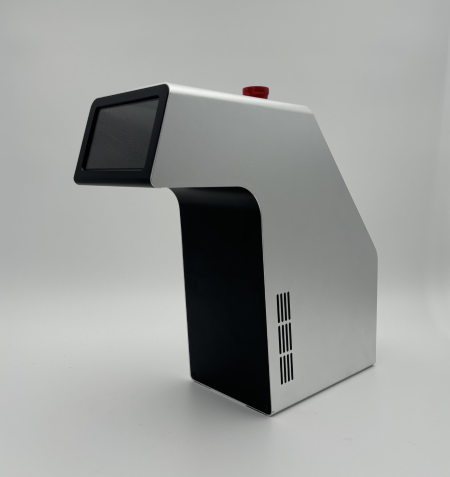
Why MOPA Outperforms Q-Switched Lasers
Tunable Pulse Parameters
MOPA lasers allow broad control over:
Pulse Widths: From ultra-short to long durations, enabling material-specific optimization.
Repetition Rate: Adaptable to various marking speeds and resolutions.
Pulse Shape: Tailored energy delivery for different textures and material responses.
Material Versatility
Unlike Q-switched lasers, MOPA systems are well-suited for sensitive or layered materials like anodized aluminum, plastics, and semiconductors—delivering clean marks without thermal damage.
Customizable Integration
MOPA lasers can be customized to meet specific application requirements, making them ideal for manufacturers seeking scalable, future-ready solutions.
Conclusion
While Q-switched fiber lasers continue to serve basic marking needs where cost is a major factor, MOPA fiber lasers are quickly becoming the gold standard in high-performance marking. Their superior tunability, material adaptability, and marking quality make them the ideal choice for advanced manufacturing environments.
For companies aiming to lead with precision and quality, investing in MOPA technology is a forward-looking decision that unlocks new capabilities across diverse applications.